More safety in cleanrooms
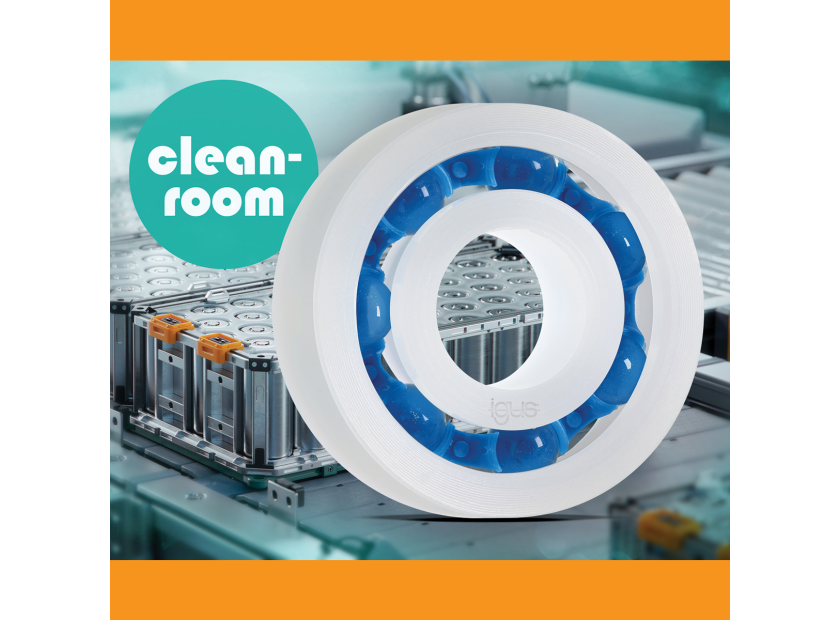
More safety in cleanrooms with new polymer ball bearings from igus
igus is adding abrasion-resistant xiros ball bearings to its portfolio for semiconductor manufacturing and battery production
In addition to energy chains, igus now also offers ball bearings made of abrasion-resistant high-performance plastics for cleanrooms. The new polymer bearings in the xiros series already fulfil the highest requirements of cleanroom production. They have been specifically developed for highly sensitive applications in battery production and the semiconductor industry, for example for use in conveyor rollers. The new ball bearings are characterised by very high resistance to abrasion and chemicals as well as minimised particle emissions.
The air in semiconductor factories must be millions of times cleaner than normal indoor air. The reason: the circuits of modern microchips are only a few nanometres in size. If a transistor were as big as a grain of rice, then a grain of dust would be as big as a whole mountain. To prevent such mini-bullets from being generated in the first place, components of automation systems in cleanrooms must be as abrasion-resistant as possible. The problem: conventional metal bearings can produce microparticles if they are insufficiently lubrication or corroded. "Recently, more and more cleanroom users have therefore been asking us whether they could switch from metal to our lubrication-free high-performance plastics," says Marcus Semsroth, Head of Business Unit xiros® Polymer Ball Bearings at igus. The company has therefore expanded its product range to include its first cleanroom-compatible polymer ball bearing. "In addition to our cleanroom-compatible energy chains, the new xiros series ball bearing is another step towards greater safety in cleanrooms," explains Semsroth.
A unique combination of materials
igus manufactures the new polymer ball bearings from three materials. The inner and outer races are injection-moulded from the high-performance plastic xirodur C161. The cage that holds the glass balls in position is made of xirodur A161. "We have developed both materials specifically for maximum robustness and resistance to abrasion and chemicals," says Semsroth. igus is currently testing the polymer ball bearings in its in-house test laboratory, which was developed and built together with the Fraunhofer Institute for Manufacturing Engineering and Automation (IPA). From six tests, three have already achieved the highest cleanroom class. A maximum of ten particles per m3 of air with a size of ≥0.1µm may be found in this cleanroom class. Particles larger than ≥0.2µm are not permitted. The ball bearings are now ready for official certification by the IPA.
Lubrication-free and therefore maintenance-free
The new cleanroom-compatible polymer ball bearings are suitable for applications with medium speeds and light loads. Installation size 6000 has a maximum speed of 1,700rpm, a static load capacity of 60N and a dynamic load capacity of 65N. The flexural strength at 20°C amounts to 27MPa and the long-term upper application temperature is 60°C. "The polymer ball bearings can therefore be used in lightweight robot arms, conveyor and support rollers, among other things," says Semsroth. "As the bearings require no additional lubrication and are therefore maintenance-free, they are an economical and safe alternative to classic metal bearings."