Hollow things fly better
Hollow things fly better: xiros hollow ball transfer units reduce weight in cargo aircraft by up to 49 per cent
The FAA-compliant solution from igus combines lightweight construction and high load capacity with permanently lubrication-free operation
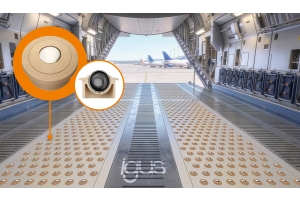
Every gramme saved counts in aviation. Even slight weight reductions can reduce fuel consumption, increase reach and raise payload. Manufacturers of cargo aircraft are therefore continuously looking for ways to save weight, even with the smallest components. These include the ball transfer units over which containers slide on the cargo hold floor. While standard market solutions often use comparatively heavy solid balls, igus is launching an alternative with its new xiros series ball transfer units. The hollow balls reduce weight by up to 49 per cent. They also work without lubrication, which decreases daily maintenance.
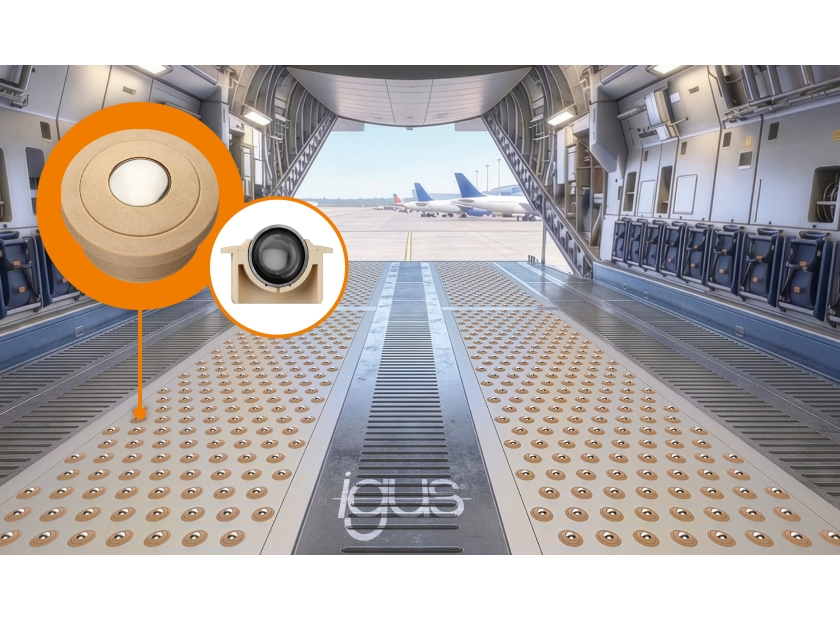
The new xiros ball transfer units from igus consist of two components: a housing made of the high-performance plastic iglidur J350 and hollow stainless-steel balls that slide in the shell. The plastic ball transfer units are approved for air traffic and comply with the fire protection requirements of the US aviation authority FAA for aircraft interiors. Several hundred ball transfer units are embedded in the floor of the cargo area. This creates a conveyor surface on which cargo containers can be easily moved in two dimensions. The new ball transfer units are available now in three sizes with ball diameters of 22mm, 25.4mm and 30mm.
High load capacity despite low weight
Manufacturers of cargo aircraft can reduce weight by up to 49 per cent weight with the xiros ball transfer units. A solid stainless-steel ball with a diameter of 25.4mm would weigh 87g. The hollow version, on the other hand, weighs only 43g. What seems small for a single ball is noticeable in the overall system: since several hundred ball transfer units are installed in the loading area of a cargo aircraft, the weight reduction can make a noticeable contribution to lower fuel consumption. With 500 ball transfer units, for example, the hollow balls alone result in a weight reduction of around 22kg per aircraft. "Design engineers do not have to worry about a possible reduction in load capacity when they switch to our system," emphasises Marcus Semsroth, Head of Business Unit xiros Polymer Ball Bearings at igus. The permissible static pressure load is 1,470N. "This corresponds to approximately the weight of 150kg that can be exerted on a single ball transfer unit." Investigations in the company's own 5,500-square-metre test laboratory have also shown that the ball transfer units could even carry up to four times the load.
Less daily maintenance thanks to lubrication-free design
Many conventional ball transfer units also require lubrication. The problem: the smooth operation can deteriorate if the lubricants bind dust and dirt. The cleaning effort increases. The igus solution: solid lubricants are integrated into the high-performance plastic of the housing. They are released during movement and allow for low-friction dry operation without external lubricants. This keeps the ball transfer units clean and makes them less susceptible to contamination caused by lubricants. At the same time, relubrication is no longer necessary. "With the new xiros ball transfer units, we are showing that lightweight design, high load capacity and freedom from lubrication can be combined," sums up Semsroth. "These are three decisive advantages for modern conveyor technology in the aerospace industry."
You can find more information about the xiros hollow ball transfer units here: https://www.igus.eu/product/xiros-btu-es-h